
In combat—real combat, not choreographed fights—speed is not about moving fast.
It’s about wasting nothing.
Every unnecessary step, twitch, wind-up, or flourish is a liability. It costs time, exposes intent, and gives your opponent information they can use against you.
That’s where the Principle of Economy of Motion comes in.
At its core, this principle is simple:
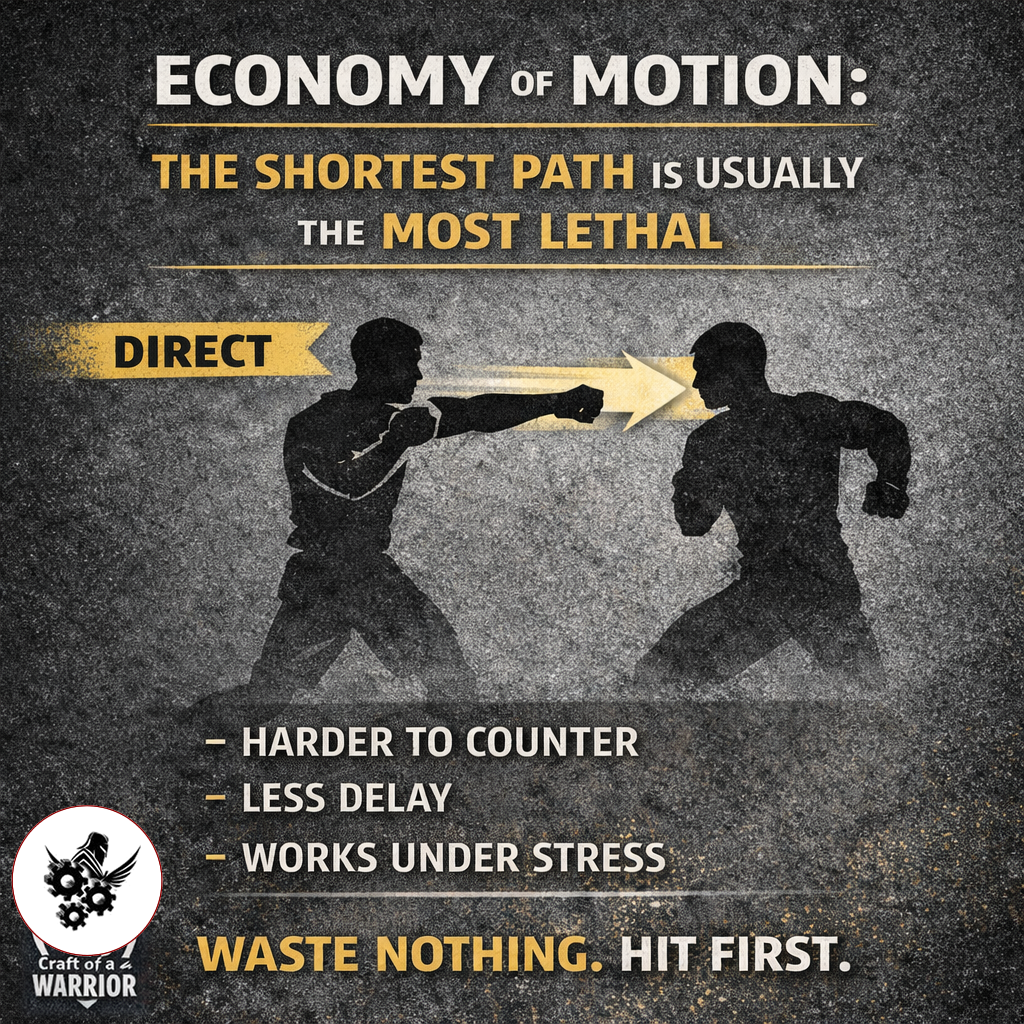
The most effective action is the one that reaches the target with the least wasted movement.
The shortest path isn’t just faster—it’s harder to detect, harder to stop, and more likely to succeed under stress.

What Economy of Motion Really Means
Economy of motion is not about being lazy or weak. It’s about being efficient under pressure.
In combat, efficiency means:
- Fewer moving parts
- Less telegraphing
- Reduced reaction time
- Lower energy expenditure
- Higher reliability under stress
A movement that travels straight to its goal has fewer chances to fail.
Compare these two actions:
- A wide, looping punch with shoulder wind-up
- A direct strike that moves only what must move
One looks powerful.
The other lands first.
And in real violence, first contact often decides everything.
Why the Shortest Path Wins Under Stress
When adrenaline hits, fine motor skills degrade. Complex techniques break down. Big movements feel tempting—but they’re slower and sloppier.
The shortest path works because:
- It requires less coordination
- It functions even when tired, scared, or injured
- It reduces decision-making time
- It limits exposure to counters
Your nervous system prefers simple solutions when survival is on the line. Economy of motion aligns with that reality.
This is why experienced fighters often look calm and minimal while beginners look frantic.
Telegraphing: The Silent Killer of Technique
Most failed techniques don’t fail because they’re “bad.”
They fail because they announce themselves.
Any extra movement:
- Signals intent
- Gives timing cues
- Allows pre-emptive defense
The shortest path removes tells.
No shoulder lift.
No step back before stepping in.
No dramatic chamber.
The strike appears where it’s needed—without warning.
That’s not flash. That’s function.
Power Comes From Structure, Not Distance
A common myth is that longer movements generate more power. In reality, power comes from:
- Alignment
- Timing
- Mass transfer
- Structural integrity
A compact movement that keeps your body connected will often hit harder than a big swing that disconnects you from your base.
Think of it like this:
- A hammer doesn’t need a big arc to drive a nail
- A piston doesn’t wind up—it fires straight
Short doesn’t mean weak.
Short means direct.
Efficiency Is Survival, Not Style
In prolonged conflict, energy matters.
Big movements:
- Burn fuel faster
- Increase fatigue
- Reduce endurance
Efficient movement allows you to:
- Fight longer
- Think clearer
- Recover faster between actions
Economy of motion isn’t about winning one exchange—it’s about not losing the next one.
How This Applies Beyond Striking
This principle isn’t limited to punches or blades.
It applies to:
- Footwork (short adjustments instead of big steps)
- Weapon deployment (draw straight to use)
- Clinch and grappling (tight control beats broad motion)
- Situational awareness (small head movements see more than exaggerated scans)
The warrior who wastes nothing sees more, reacts faster, and stays balanced.
Training for Economy of Motion
You don’t train this by going faster.
You train it by:
- Slowing down
- Removing excess movement
- Keeping actions compact
- Maintaining balance throughout the motion
Ask yourself:
- Does this movement need to be this big?
- What part of this motion could be removed?
- Can the same result be achieved with less?
Efficiency is not added.
It is revealed by subtraction.
Final Thought: Lethality Is Quiet
The most dangerous fighters often don’t look dangerous at all.
They don’t rush.
They don’t flail.
They don’t announce.
They move only as much as necessary—and no more.
The shortest path isn’t lethal because it’s brutal.
It’s lethal because it arrives before the other person understands what’s happening.
That is economy of motion.
And it’s one of the core truths of Combat Craft.

Leave a Reply
You must be logged in to post a comment.